
The cooperation between the European Centre for Electoral Support (ECES) and the African Union Commission’s Department of Political Affairs, Peace and Security (AUC-PAPS) is rooted in the Memorandum of Understanding (MoU) signed in May 2021, which aims to strengthen collaboration in promoting electoral integrity, preventing electoral conflicts and violence, and advancing human rights and women’s political participation across the African continent. In line with the respective mandates of both institutions, the MoU established a framework for closer cooperation through regular consultations, joint activities, and the exchange of expertise and information related to democratic governance and electoral processes.

The MoU further recognised the complementarity between ECES and the AU in supporting regular, credible, inclusive and peaceful elections, while contributing to conflict prevention and the consolidation of democracy and the rule of law in Africa. In this framework, ECES and the AUC identified three key areas of cooperation: the promotion of electoral integrity through activities such as voter education, media monitoring, support to political parties and parliaments, institutional communication; the prevention and mitigation of electoral violence, including through early warning mechanisms and the implementation of ECES’ Leadership and Conflict Management (LEAD) methodology; and the strengthening of human rights and the political participation of women, youth and disadvantaged groups in electoral processes.

Following the signature of the MoU, ECES and the AUC jointly conceived and implemented the Pro-Electoral Integrity Project, which has provided technical support to a broad range of electoral and democratic stakeholders throughout Africa. The project aimed at creating conducive conditions for peaceful and active citizen participation, preventing electoral conflicts, promoting electoral integrity, and strengthening constitutionalism and the rule of law.

As per the AU 2063 agenda, national capacity building, information sharing, and coordination at the regional level are needed to boost regional integration. The AU has a critical role to play in this regard, including sharing best practices and comparative experiences via electoral assistance. Consequently, the project’s proposed specific objectives are distilled into seven strands:

  1. Promotion of electoral integrity through strengthening the capacities of AU Member States’ EMBs to conduct credible, transparent, peaceful, sustainable elections, focusing on countries exiting from complex political situations and affected by fragility (Libya, South Sudan, Somalia, Gambia, Chad, Mali, Sudan, and the Horn of Africa among others);
  2. Support Civic and Voter Education programming and peace outreach activities in the AU Member States;
  3. Strengthening political parties’ system of member states within Africa;
  4. Enhancing the capacities of the AU Election Observation Missions (AUEOM);
  5. Support to parliamentarians and parliamentary institutions;
  6. Strengthening electoral dispute resolution mechanisms and;
  7. Enhancement of human rights, mainstreaming gender, enhancing women's political participation and inclusive action for marginalised groups in Africa’s electoral processes.

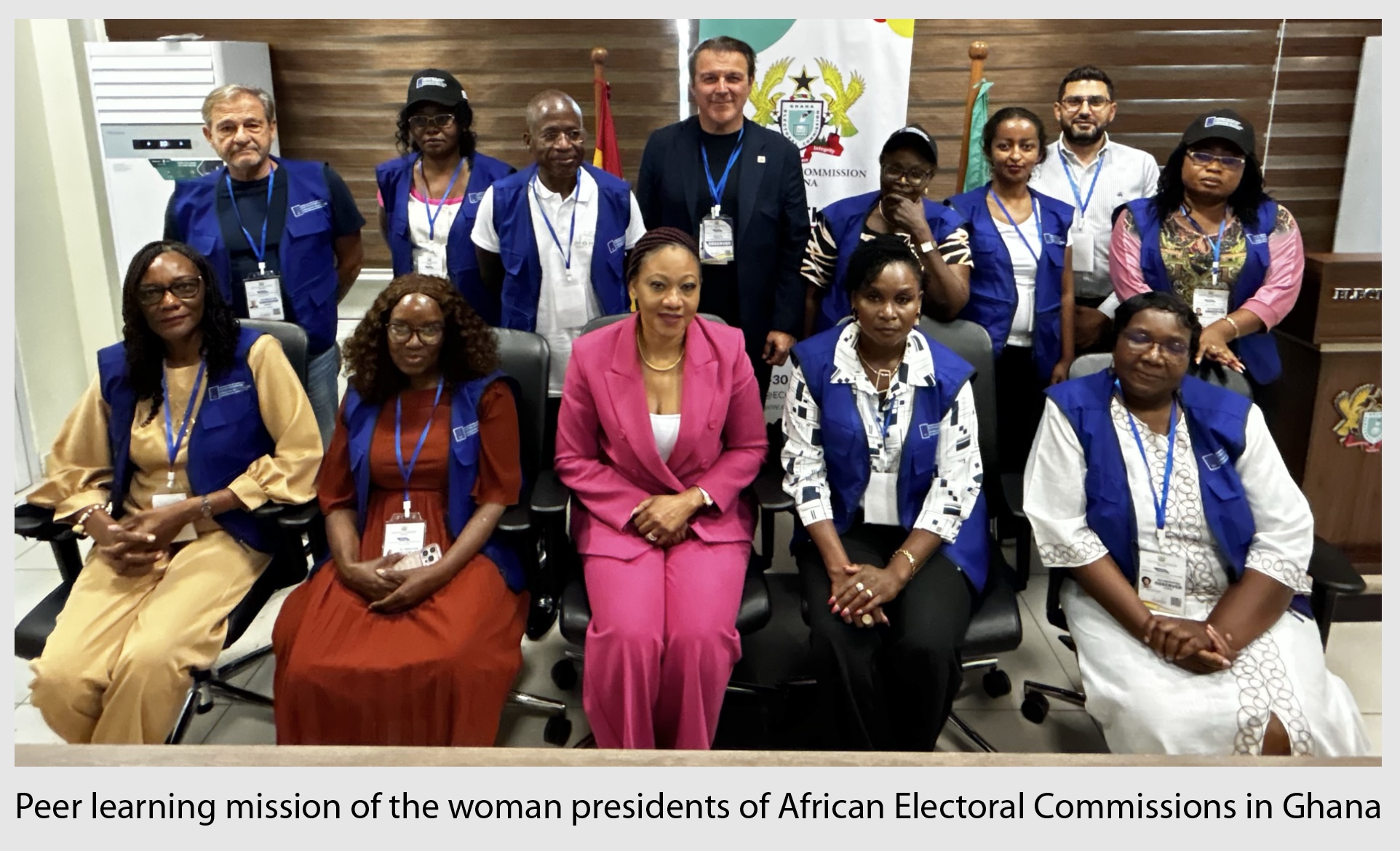
One of the project’s major achievements has been the promotion of peer learning and cooperation among African Electoral Management Bodies. Through peer learning and exchange, EMB chairpersons, commissioners, and senior electoral officials from across Africa exchanged experiences, shared best practices, and provided mutual support during electoral periods. These missions strengthened regional solidarity and contributed to building a common culture of electoral integrity and institutional resilience among African EMBs.

The project supports flagship AU initiatives in the areas of democracy, constitutionalism, electoral assistance and conflict prevention through two main result areas: Conflict Prevention and Post-Conflict Peacebuilding. In this regard, the project has supported the 7th, 8th and 9th Annual Continental Forum of Electoral Management Bodies and also foresees support to the organisation of the 10th Annual Continental Forum of Electoral Management Bodies.

Particular emphasis is also placed on the continuation and expansion of the AU project for the inclusion and mainstreaming of the African Charter on Democracy, Elections and Governance (ACDEG) into African school curricula. Following successful pilot launches in Côte d’Ivoire and Guinea-Bissau, the project intends to expand the initiative to all five regions of Africa through the development and implementation of pedagogical materials promoting democracy, constitutionalism, human rights and the rule of law.

In addition, the project also continues to support the AU’s work on Transitional Justice, including women- and youth-focused forums, promoting inclusive dialogue, peacebuilding, and reconciliation processes in post-conflict contexts. Furthermore, it seeks to enhance women’s and youth participation in democratic processes, combat electoral violence and disinformation, and reinforce the rule of law and good governance throughout the continent.

The AU-ECES partnership has progressively evolved into a strategic framework for supporting democratic governance, electoral integrity, conflict prevention and inclusive political participation across Africa. The flexibility and adaptability demonstrated throughout the implementation of the first three phases of the Pro-Electoral Integrity Project have allowed ECES and the AUC-PAPS to respond effectively to emerging priorities and strengthen African-led approaches to democratic consolidation and peacebuilding.